Most people know the Boy Scouts as an organization built on camping, leadership, service, and learning how to navigate the outdoors. What many do not know is that one of the earliest and most compelling chapters of that story leads straight to Burnside, Kentucky.
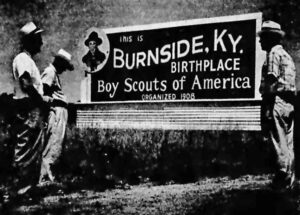
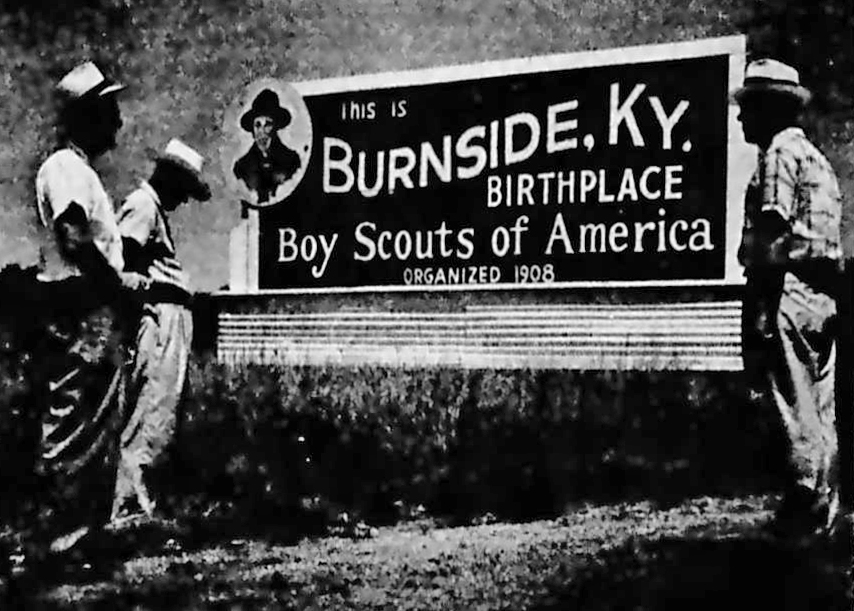
Tucked along the Cumberland River and now resting beside Lake Cumberland, Burnside proudly claims a distinction few small towns can: it is widely recognized as the birthplace of the first Boy Scout troop in America.
That claim surprises many visitors. They expect such a story to begin in a major city or on a famous East Coast campus. Instead, the roots of Scouting in the United States may trace back to a hardworking Southern Kentucky river town where young boys learned practical skills, self-reliance, and respect for the land long before those ideas became formalized in America.
The Story Begins in 1908
Long before the Boy Scouts of America was officially incorporated in 1910, Burnside had already organized something remarkably similar.
According to the Kentucky Historical Marker in Burnside, a local woman named Mrs. Myra Greeno Bass formed a troop of fifteen boys in the spring of 1908. Using the official handbook of English scouting, she guided them in hiking, camping, and outdoor activities much like Scouting today. The group became known as the Eagle Troop, and Horace Smith was listed as troop leader.
That date matters.
If the marker and local records are accurate, Burnside’s troop was organized two years before the Boy Scouts of America officially formed in 1910. That is why Burnside continues to celebrate its place in Scouting history.
Why Burnside?
To understand why something like this could happen here, you have to understand what Burnside once was.
Before Lake Cumberland changed the landscape, Old Burnside was a lively transportation and trade center. The town sat at an important river crossing and rail connection. Steamboats, trains, mills, stores, hotels, and travelers moved through regularly. It was a place where ideas arrived from outside the region and where hardworking local families valued discipline, resourcefulness, and community.
Burnside was not isolated. It was connected.
That matters because Myra Greeno Bass is believed to have obtained British scouting materials and brought those ideas home. In a town already shaped by the outdoors, rivers, woods, work ethic, and close-knit families, the concept of youth learning through skill-building and character likely felt natural.
In many ways, Burnside was exactly the kind of place where Scouting would make sense.
A Kentucky Version of Scouting
It is easy to picture what those early days may have looked like.
Boys learning knots, hiking trails, cooking outdoors, and helping neighbors. They would have known rivers, hillsides, timber, weather, and responsibility. Many likely already carried chores and duties beyond their years.
That is part of what makes Burnside’s claim so believable.
Scouting’s ideals were not foreign to rural Kentucky. They were already woven into daily life. The handbook may have provided structure, but the values were already here.
Did Baden-Powell Visit Burnside?
Some retellings of the story mention Scouting founder Robert Baden-Powell visiting Burnside. However, strong historical documentation more consistently supports the story of Myra Greeno Bass organizing the Eagle Troop in 1908 rather than a confirmed Baden-Powell visit.
What is clearly documented is that British Scouting ideas reached Burnside very early, and local residents turned those ideas into action before the national American organization formally existed.
That alone is a remarkable story.
Why This Story Matters Today
Small towns often contribute to American history in ways that are overlooked. Burnside’s connection to Scouting is one of those stories.
It reminds us that leadership does not always begin in large cities. Innovation does not always start in famous places. Sometimes it begins in a town beside the river, where someone sees potential in young people and decides to invest in them.
That spirit still feels familiar in Burnside today.
Community pride, outdoor life, neighborliness, and teaching the next generation still matter here.
Visit the Legacy in Burnside
Burnside continues to honor this history through signage, historical markers, and local storytelling. Travelers passing through may see the community’s proud reminder that they are entering the Birthplace of the Boy Scouts in America.
For locals, it is a point of pride.
For visitors, it is one more reason to look a little deeper when exploring Southern Kentucky. Beneath the lake views and quiet beauty is a town whose story helped shape something much bigger than itself.
And that is the kind of history worth pulling off the road for.